
When a parent stops paying child support, the state does not just sit back and wait. Idaho has several tools that can force payment or push a parent toward a solution. Whether you are owed support or you have fallen behind, knowing how these tools work can help you plan your next step.
Who Enforces Child Support Orders in Idaho
Most child support cases in Idaho are handled through the Idaho Department of Health and Welfare, Child Support Services division. This agency can start many enforcement actions on its own, without a judge signing off on every step first. Once a parent falls behind, the case may move through several stages of collection.
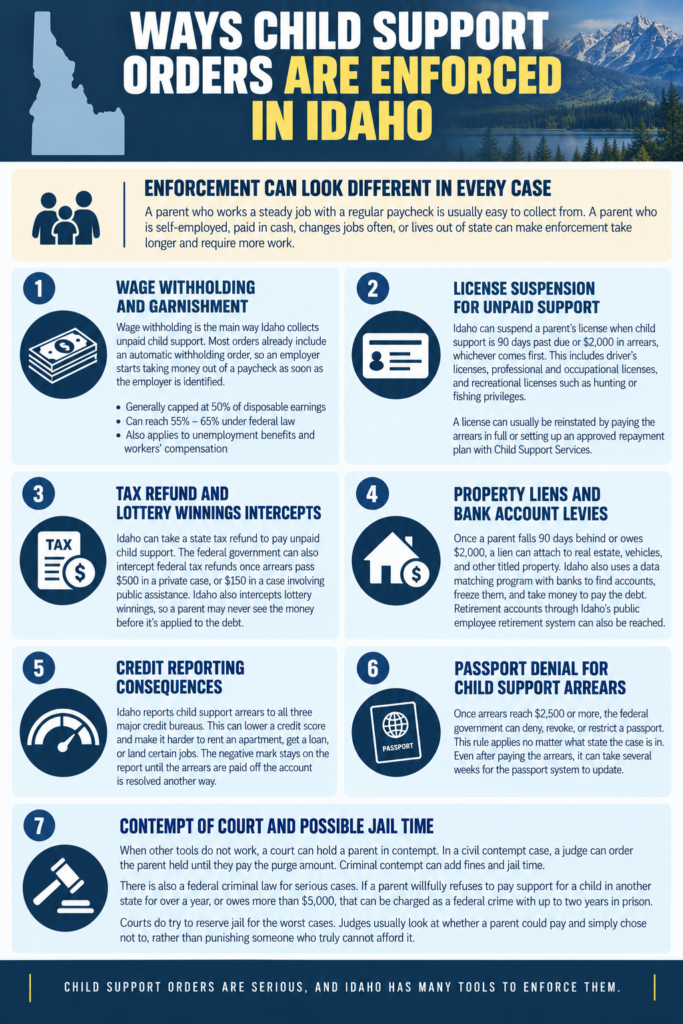
Some situations are harder to enforce than others. A parent who works a steady job with a regular paycheck is usually easy to collect from. A parent who is self-employed, paid in cash, changes jobs often, or lives out of state can make enforcement take longer and require more work.
Wage Withholding and Garnishment
Wage withholding is the main way Idaho collects unpaid child support. Most support orders already include an automatic withholding order, so an employer starts taking money out of a paycheck as soon as the employer is identified.
Idaho law limits how much can be taken from a paycheck. Generally, withholding is capped at 50 percent of disposable earnings per pay period. Employers can also charge a small processing fee, often around 5 dollars per pay period, and they must send the withheld money in within about a week.
Federal law adds a few more layers on top of the state rule. Under the Consumer Credit Protection Act, the cap can rise depending on the parent’s situation:
- 50 percent if the parent is supporting another spouse or child
- 60 percent if the parent has no other family to support
- An extra 5 percent on top of either number if the arrears have been building for more than 12 weeks
This means the true ceiling can reach 55 to 65 percent in some cases. Support can also be withheld from unemployment benefits and workers compensation payments, not just a regular paycheck.
License Suspension for Unpaid Support
Idaho can suspend a parent’s license when child support falls too far behind. The trigger point is 90 days past due or 2,000 dollars in arrears, whichever amount is reached first.
This is not only about a driver’s license. Idaho can also suspend professional and occupational licenses, along with recreational licenses such as hunting or fishing privileges. For someone who needs a license to work, this can create a serious problem fast.
The good news is that suspension is not permanent. A parent can usually get a license back by paying the arrears in full or by setting up an approved repayment plan with Child Support Services. Acting quickly, before a suspension actually happens, gives a parent more options.
Tax Refund and Lottery Winnings Intercepts
Idaho can take a state tax refund and send it toward unpaid child support. This happens through a notice sent to the Idaho State Tax Commission. If the parent filed a joint return, the other spouse may be able to claim their share back through an injured spouse request.
At the federal level, the Treasury Offset Program can grab a federal tax refund too. This kicks in once arrears pass 500 dollars in a private case, or 150 dollars in a case involving public assistance.
Idaho also intercepts lottery winnings. If a parent who owes back support wins a prize, the winnings can be redirected to pay down the debt before the parent ever sees the money.
Property Liens and Bank Account Levies
Once a parent falls 90 days behind or owes $2,000, whichever comes first, a lien can attach to their property automatically. This includes real estate, vehicles, and other titled property. Once the lien is in place, the parent usually cannot sell or refinance that property until the support debt is paid.
Idaho also uses a data matching program with banks to find accounts that belong to parents who owe support. When a match turns up, the state can freeze the account and take money out of it to pay the debt. Retirement accounts through Idaho’s public employee retirement system can be reached in the same way.
Credit Reporting Consequences
Idaho reports child support arrears to all three major credit bureaus. This can drag down a credit score and make it harder to rent an apartment, get a loan, or even land certain jobs. The negative mark stays on the report until the arrears are paid off or the account is resolved another way.
Passport Denial for Child Support Arrears
Once arrears hit 2,500 dollars or more, the federal government can deny, revoke, or restrict a passport. This rule applies no matter what state the case is in. It often catches people off guard right before a trip, whether for work, a family event, or a vacation. Once the arrears are paid, it can still take several weeks for the passport system to update, so this is not something to fix at the last minute.
Contempt of Court and Possible Jail Time
When other tools do not work, a court can hold a parent in contempt. In a civil contempt case, a judge can order the parent held until they pay what is called the purge amount. Criminal contempt can add fines and jail time on top of that.
There is also a federal criminal law that applies in serious cases. If a parent willfully refuses to pay support for a child in another state for over a year, or owes more than $5,000, that can be charged as a federal crime with up to two years in prison.
Courts do try to reserve jail for the worst cases. Judges usually look at whether a parent could pay and simply chose not to, rather than punishing someone who truly cannot afford it.
What To Do If You Are Behind on Payments
Falling behind does not mean a parent should just stop paying and hope it goes away. Arrears build up as a judgment and cannot be reduced after the fact, even if income drops later.
If circumstances have changed in a real way, such as a job loss or a big pay cut, the right move is to ask the court for a modification. This adjusts payments going forward. It does not erase what is already owed.
A few practical steps can help:
- Respond to any notice about enforcement right away
- Pay what can be paid, even if it is not the full amount
- Set up a repayment plan before a license suspension or lien happens
- Ask about a modification if income has genuinely changed
- Keep records of all payments and communication
Frequently Asked Questions
How much can be taken from my paycheck for child support in Idaho?
State law generally caps withholding at 50 percent of disposable earnings, but federal rules can push that number as high as 55 to 65 percent depending on the parent’s family situation and how long the arrears have built up.
Can I lose my license just for being a little behind on child support?
Not for a small amount. Idaho generally waits until a parent is 90 days behind or owes 2,000 dollars, whichever happens first, before starting the suspension process. There is usually a warning period first, so acting quickly can prevent it from moving forward.
Will I go to jail if I cannot pay child support?
Jail is possible through contempt of court, but it is usually a last resort. Courts look at whether a parent had the ability to pay and chose not to, rather than jailing someone who genuinely cannot afford the payments.
Contact Foley Freeman, PLLC
Falling behind on child support, or trying to collect it, can feel overwhelming. These enforcement tools involve deadlines, paperwork, and rules that change depending on your situation. Foley Freeman, PLLC, works with Idaho families dealing with child support enforcement, modification, and related family law matters. Call 208-888-9111 to talk with our team about your case and what your options look like.